Showing posts with label Asia. Show all posts

Sunday, 3 November 2019

Say yes to palm oil and save the orangutan!


Sweat dripped into my eyes and my heart pounded in my ears as I stumbled along the overgrown path towards my destination. It was around 30C and humidity was close to 100%; not a whisper of a breeze provided any respite, yet the leaves rustled and chattered around me, teeming with life. 

Although we were alone on the path, a cacophony of sounds met my ears; the hoarse calls of hornbills soaring overhead, the snapping of twigs as red-leaf monkeys traversed the canopy above my head, and the murky-brown river crashing through the valley below.

Danum Valley
View of the canopy in the Danum Valley

I was in the depths of the primary rainforest in Malaysian Borneo, three hours from the nearest town, trekking through a dense jungle trail with my guide, Dean. We had already climbed to a lofty viewpoint, along a trail littered with coffins from the previous inhabitants of the forest many years before, where I had been startled by the sheer scale of forest around me –  a sea of green reaching as far as I could see in every direction – and now we were descending back to the valley floor below for a well-deserved cold drink by the Danum River.

Danum Valley
Dean overlooking the canopy

Suddenly Dean, who was ahead of me, stopped dead and cocked his head to one side. Listening. I could hear nothing out of the ordinary, but he remained silent for a couple of minutes, and then pointed to the trees off to the side of the path.

“Wait and watch there,” he whispered, gesturing to a perfectly motionless patch of green around 20 feet ahead.

I followed his instructions, straining to try and hear what Dean had, but nothing caught my ear for several minutes above the tireless screeching of the cicadas. Suddenly, a slight rustling and the tops of the canopy twitched slightly. Blink and you’d miss it. Still we waited. Finally, through the leaves and the murky darkness of the rainforest, I saw a figure ambling slowly, quietly through the towering trees towards us. I squinted, then gaped, elated. This was what I had travelled halfway around the world to see, and yet hadn’t dared to dream that I would.

A large, male orangutan loomed through the murky light, grasping the branches of a tree just a few feet in front of me, reaching for whatever delicacy lay at his hands. He was bigger than I had expected, yet far more graceful. His cheek pads and lengthy arm span gave away his stature and gender, although he blended seamlessly into his surroundings from a distance. When I peered closer, I could make out the burnt orange colour of his hair, and the dark, textured skin around his solemn eyes. He had a very human-like expression on his face as he considered his snack.

He paid Dean and I no consideration at all, yet I knew that he knew we were there. He paused, sniffed, and continued to eat, before sensing something in the forest above us and ambling down the hillside, away from our vantage point, branches crashing in his wake. I let out a shaky breath I hadn’t realised I’d been holding.

Danum Valley
Braving the canopy walkway in the Danum Valley

Here, in the middle of the primary rainforest, in a world far away from anything I had ever imagined, I’d had my first encounter with a truly wild orangutan, and it was the most magical moment I could ever have dreamed of. It hadn’t even occurred to me to try and pick up my camera; I’d been rooted to the spot and couldn’t take my eyes from his. I was hooked and knew that nothing would ever be the same again. I had fallen in love with this beautiful island and the creatures that called it home.

Orangutan
Baby orangutan clinging to its mother

The start of my love affair with Borneo was auspicious, and I have been lucky enough to see my beloved orangutan on every visit since. I have cruised along the tributaries of the Kinabatangan River, stumbling upon herds of pygmy elephants splashing on the banks and dodging fallen branches from the proliferate proboscis monkeys above, their large noses protruding through the leaves. I have stayed on board on a traditional Indonesian klotok on the Sekonyer River, eating a delicious homemade rendang curry with the Milky Way sparkling in the night sky, bioluminescent plankton glittering ahead as the boat cut through the water, and fireflies lighting up the river banks like Christmas trees.

Tanjung Puting
Overlooking the Sekonyer river

And yet there is something so heart-breaking about each and every experience; a tinge of sadness that cuts through even the most magical of encounters. The orangutan, along with many other species endemic to Borneo, are critically endangered, and each time I visit I know that this may be my last sighting. That, unless things improve, my future children aren’t going to be able to have the same incredible wildlife experiences that have shaped me.

The protected areas of forest, home to diverse wildlife on both the Malaysian and Indonesian sides of the island are shrinking quickly; in the Danum Valley I was surrounded by primary rainforest as far as the eye could see, yet I had driven through oil palm plantations for almost three hours to reach the protected sanctuary. The Kinabatangan River is a diverse wildlife corridor, one of the best places to see all of Borneo’s endemic species, yet it is only so because it is a narrow, protected haven surrounded by acres of uniform oil palm trees. Sailing up the Sekonyer River in Kalimantan, the Tanjung Puting National Park stretches to the horizon on the right-hand side of the river. On the left, oil palm plantations stretch to the opposite horizon.

Kinabatangan River
Sunset over the Kinabatangan River

On the surface, this can seem devastating. The media constantly shows images of rainforest contrasted against deforested land and sparse oil palm plantations alongside calls for a boycott on palm oil, as if to emphasise the pure evil of the industry. It’s true that palm oil is one of the primary causes of deforestation that has caused the decline of the orangutan and other endemic species on the island, although they have also been kept as pets and sold on the black market. But the issue is not as black and white as it may seem.

Palm oil itself is not an inherently evil substance. It is an incredibly efficient crop that provides 35% of the world’s vegetable oil on just 10% of the land. It is in over 50% of products on supermarket shelves, including chocolate, cakes, pet food, spreads, toiletries and cleaning products. The palm oil industry employs 16 million people worldwide, 4 million of those in Indonesia alone.

 Malaysia and Indonesia supply around 90% of the world’s palm oil, and it is one of the main income generators for the two countries that are teetering on the brink of poverty. Indonesia in particular has a population of 272 million people to support, on 17,000 islands which are prone to intense natural disasters. It relies heavily on palm oil both for its economy and as a source of employment. 10% of its population are currently on or below the poverty line; without the palm oil industry it would be many more.

Orangutan
Baby orangutan in Tanjung Puting National Park

The problem with palm oil is not the substance itself, it is the way it is grown. Thriving in hot and humid climates, it grows best along the equator, where land is already inhabited by rainforest. This is then deforested and replaced by oil palm plantations on the fertile peat soils. When the fruit is harvested, the cheapest and easiest way to clear the land for a new crop is simply to burn it, draining the peat to expediate the process and exhausting the soil in the process.

This means that new land must then be cleared to make way for new plantations, leading to much more widespread deforestation. These slash and burn practices also lead to out of control forest fires, creating a smog of haze over much of Southeast Asia as the dry season draws to a close in September and October. These practices are now illegal in both Malaysia and Indonesia, but policing this is difficult; particularly in Indonesia where resources are thin, and palm oil is big money.

Tabin
Guide looking for wildlife in Tabin Wildlife Reserve

The Roundtable on Sustainable Palm Oil (RSPO) was created in 2004 in response to increasing concerns around the environmental impact of the oil palm plantations. As well as loss of habitat for the wildlife of Borneo and Sumatra, the loss of the canopy meant that carbon emissions were increasing.

The RSPO has been working to create a set of criteria that both producers and consumers must comply with to ensure that palm oil is grown in a sustainable way. Whilst calls for an out and out boycott of palm oil were initially supported, it soon became clear that this would be catastrophic both for the environment, and for the economies of Malaysia and Indonesia.

Not only would 16 million people be out of work, with little chance of finding other employment, but it would be nigh on impossible to find a more efficient crop. Therefore, a more destructive cash crop would simply take the place of palm oil, moving the problem elsewhere and causing further deforestation. The root of the problem would not be solved. Increasingly the emphasis has been put on deforestation-free palm oil, meaning that plantations are grown on land that has already been deforested. The RSPO is working with grassroots movements throughout Southeast Asia to incentivise sustainable plantations and has created resources for consumers around the world to support the practice.

By purchasing products made with palm oil from a sustainable source and boycotting those which are not, this encourages large corporations to continue to source their palm oil sustainably, and thus incentivises producers to create deforestation-free plantations. An out and out boycott of palm oil is only a good option of the alternative is purchasing from an unsustainable source. The RSPO logo is appearing increasingly on products on supermarket shelves, and Chester Zoo – a huge proponent of sustainable palm oil – has created a fantastic shopping list with brands who have proven they source their palm oil sustainably.

There is still a lot of work to be done on this, and this is just the first rung of an increasingly growing list of things that must be considered going forwards. There are some arguments to suggest that the criteria for sustainable plantations aren’t stringent enough, as an example, but the rules and regulations can only improve with enough support and funding, and so this first step is crucial for the sustainable palm oil movement as a whole.

orangutan

Sabah in Malaysian Borneo committed in 2015 to certifying all of its palm oil to RSPO standards and to increase protected area coverage to 30% by 2025, and it is already 25% of the way there. Indonesia is some way behind, although it has more pressures on its economy than its neighbour; it is here that incentivising sustainable palm oil financially could have the biggest impact.

Supporting sustainable palm oil is not the only way that you can help to conserve the rainforest in Borneo. Tourism is also one of the main income generators and employers in both countries, and this is often in conflict with the palm oil industry. Visitors travel to the darkest depths of the Bornean rainforest in search of the island’s most iconic species, with images of deep, dark canopies untouched by humans, and an undergrowth teeming with life; not of bumpy journeys along logging tracks and many acres of oil palm to reach the haven of the rainforest.

Yet by visiting these protected areas you are contributing national park fees that go towards the forestry departments and conservation charities; you are contributing to the wages of guides, chefs, cleaners, maintenance staff and drivers in the area; you are buying snacks and souvenirs that directly contribute to the local economy. You are preventing the surrounding rows of palm oil from encroaching ever further into the canopy beyond.

Put simply, by searching for that once in a lifetime orangutan moment, you are funding an industry that by its very nature must protect the habitat of this critically endangered species and are incentivising the Malaysian and Indonesian governments to keep that forest home alive.

When I asked Dean, after that first magical moment, how he had known that the orangutan was there, he simply said that he had both heard and smelt him, his senses honed by years of guiding and co-existing with these great apes in their forest home. I have been back to Borneo a further 5 times since that first visit and, whilst my skills have improved slightly, I am still nowhere near the level of the impressive naturalist guides and continue to be awed by what they can do.

In my happy place, searching for orangutan on the Sekonyer river

 I am currently planning my next foray back to that most diverse of islands, deciding whether to revisit old haunts or to dip my toe into unknown territory. One thing is for certain; whether it’s my first encounter or my last, I will never take a glimpse of burnt-orange hair or wise brown eyes for granted and hope that, when I am grey of hair and wrinkled of face, I will still tread through the undergrowth, listening for the rustle of trees, safe in the knowledge that the ‘man of the forest’ is protected and thriving for many generations to come.

Resources


Thursday, 16 July 2015

Phnom Penh

After spending a week in Thailand with our partners over there, it was time for my holiday! I was a little apprehensive about spending a week alone in Cambodia, but excited at the same time.

When I was planning my trip, I couldn't decide whether to use the second week to see more of Thailand, or whether to head over to Cambodia. I decided on the latter option mainly because I'm a history geek, but also because it's easier to cover Cambodia in a short period of time. There are obviously bits I want to go back and explore further, but I've done most of the things that were top of my list, whereas I'll need a little longer in Thailand.

Because I had such a short amount of time to spare, I planned every day as much as possible before I left. On my return to Bangkok, I explored the Grand Palace before heading to Dong Muang airport for my Air Asia flight to Phnom Penh at 3.20pm.

As I mentioned in my previous post, I was a big fan of Dong Muang airport. It's small, easy to navigate, but has some great options for food and drink that won't break the bank. It's where all Air Asia flights fly from, as well as most domestic flights, and I got there early enough to spend some time watching the planes before I departed. For some reason (as I'm terrified of flying), this always help reassure me before a flight.

The journey from Bangkok to Phnom Penh took just over an hour, and I have a lot of great things to say about Air Asia. I plan to do a separate post on them later (I'm aware my trip has already taken me a few months to blog, but in my defence I didn't have a laptop for a while...) but I'd highly recommend flying with them.

On arrival into Phnom Penh airport, I headed to immigration to apply for my visa. It's an incredibly simple process - $30 and a passport picture gains you access to the country. I also had to fill in a quarantine form on arrival, which I found fairly pointless. Surely I could just lie if I had any medical issues?

I had a few dollars with me just in case I got stuck in the airport, but made sure to take some more out before heading into the city, as the last thing I wanted was to be caught short. The main currency in Cambodia is the US dollar, and they only accept relatively recent notes. They will charge you in USD, but don't be surprised to receive change back in Riel, the local currency. You can't buy much with this, other than water and snacks, but it's always good to have some handy. You can also use it to pay tuk-tuk drivers.

Whilst the tuk-tuk is the way to get around in Cambodia (unlike Thailand where it's mainly used as an attraction for tourists), I wanted to gain confidence first, and to gain my bearings, so I used a metered taxi to find my hostel. The taxi rank is signposted, and there are airport staff there to help tell the driver where to go. I found English to be spoken to a much better standard in Cambodia than in Thailand, so fortunately I didn't have to struggle for words. My friend Chris lived there for a year, so I'd got some key phrases from him before I left, but I'm ashamed to say I didn't say anything more than please and thank you the whole time I was there. English is widely spoken, and the Khmer language is much more tricky to say than Thai!

Accommodation


Deciding where to stay was one of my biggest problems in Phnom Penh. I'm not a big party-goer, especially when travelling alone (I prefer not to drink when this is the case) so I decided not to stay on the riverfront. This is where most of the cheap hostels are, but I thought I wouldn't see much of the culture there, and it's less safe as it's obviously a magnet for tourists. Similarly, as I was travelling alone for the first time, I still wanted to meet people and didn't want to be in the middle of nowhere.

After going backwards and forwards a few times with suggestions from Chris (who lived in Phnom Penh), I decided on the Envoy Hostel. I trawled through the reviews on all the hostel websites, and this regularly had good ones, and the place looked clean and cheerful.

Envoy started as a hostel in Armenia, and has recently spread to Georgia and Cambodia. The staff are incredibly helpful and the building itself is stunningly modern and clean. For Phnom Penh, as I wanted to meet people preferably, I booked a dorm room for the only time during my entire trip. I chose a female 6 bed dorm, purely because I thought it might mean I met people that were on a similar wavelength to me, and the price was good at around $10/night. I was in Phnom Penh for two nights in total, but three full days as the third night was to be spent on an overnight bus to Siem Reap.

Unfortunately, (or fortunately for some) the hostel was very, very quiet while I was there. This meant that I had the entire dorm room to myself for the entire time I was there. It was great to get a big, essentially private, room to myself, but didn't exactly help with the meeting people part! The hostel communal area was perhaps the only downside - there were some sofas in reception and a few tables in the kitchen area, but not really space where people could relax and meet each other. There was also a roof terrace, but as the hostel was so quiet, I never saw anyone else up there.

Envoy Hostel Dorm

I got chatting to a couple of girls in reception on the first night, but they were leaving. The only other people I saw whilst I was there was a mother and her young son, and a few groups of boys. I think had I been there longer, I'd have met more people as I was chatting to some others on my last day, but for two nights I wasn't too bothered to be alone; particularly as I'd just spent a frantic week meeting lots of different people. It was quite nice to relax, and I do enjoy my own company, but I'd perhaps have felt a bit more confident had I been with others.

The hostel is a bit out of the way, and it's still quite new so not many taxi/tuk-tuk drivers know it yet. Fortunately, all the streets in Phnom Penh are labelled numerically, so it didn't take them long to find it. On the first night, I was completely exhausted, so I stocked up on food from the supermarket just down the road, and used the (free!) Wi-Fi to catch up on the comings and goings of the world, and generally just to relax. I also managed to wash my clothes for the first time - the laundry service was super cheap (you pay by the kilo) and it was so nice to have some non-sweaty clothes for the first time in a week! I'm still unsure on the etiquette of giving hostels your underwear to wash, so I washed them in the shower just in case. Not quite the same, but it did the job haha!

The Killing Fields and S21


I'd planned to visit the Killing Fields and S21 museum the next day, as this was my main reason for visiting Phnom Penh. Everything else would be a bonus. It's really easy to book a tour of these, although I went through the hostel. Envoy have a great system where you can put your name down for a tour, and others can do the same so you can share the cost of a driver. Sadly, I just missed the first tuk-tuk which filled up before I went to reception, so I did end up on a tour alone as the hostel was so quiet. Fortunately I had budgeted for this, and it meant I could go at my own pace, but it would have been nice to share it with someone. In the busier periods, this is a great system, and something I'd recommend doing.

Chris had told me to do the museum first, before heading out the the Killing Fields, but most tours do it the other way around. I do agree with Chris' reasoning for this (the museum gives you the history so you can understand what you're seeing at the Killing Fields), but as I'm a history geek and had done some research anyway, it didn't make much difference to me.

Spirit House S21

I'm going to do a separate post about Tuol Sleng and Choeng Ek (the museum and Killing Fields) as this post is already long and I have a lot to say about it. It's absolutely incredible what the Khmer people have suffered in such recent history, and I felt incredibly emotional at the end of the day. I wanted time to reflect on what I'd seen, so headed back to the hostel rather than into town, and spent the rest of the evening there. There are some lovely restaurants within a short walk from the hostel, and I went to the Blue Pumpkin, a prolific cafe all around the main areas of Cambodia, which serves ice cream, cake, pizza and soft drinks. More than that, the decoration is white and minimalist, with amazing air conditioning, and it gives you a huge sense of calm and relief from the frenetic city outside.

The Royal Palace and Wat Phnom


The next morning, I checked out of the hostel after breakfast (they provide you with an egg, fruit and toast for free), but left my bag there as I was due to get the overnight bus to Siem Reap that night. I headed into town to visit everything else there is to see in Phnom Penh, with the main aims being the Royal Palace, Wat Phnom and the river. There were always tuk-tuks outside the hostel, with rides into town at a very reasonable price ($5 for about a 10 minute trip), but I had all day to kill. I looked at the map, and the Palace looked really close to the hostel (pretty much just down the road and no more than a 30 minute walk), so I decided just to saunter there instead. My plan was to walk there, visit the palace and the national museum; then to have lunch and get a tuk-tuk over to Wat Phnom. I then wanted a boat trip on the river and to grab some dinner before heading back to the hostel to get my bag and then my bus to Siem Reap.

That didn't happen, for the most part. I walked to the Palace, but had massively underestimated that kind of distance in the heat and humidity. It was really difficult to cross the road in some places, I was constantly hassled by tuk-tuk drivers, and by the time I arrived I was a sweaty, dehydrated mess.

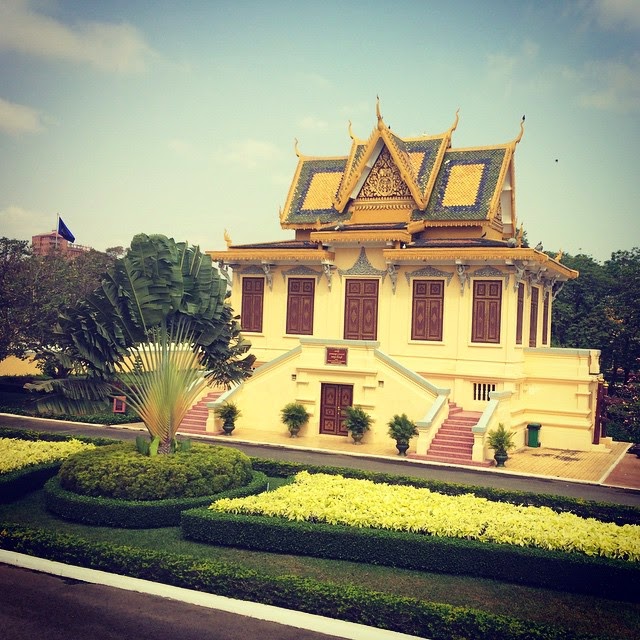
I sat down for a few minutes and downed a bottle of water before heading inside, which certainly helped a little. The Royal Palace and the Silver Pagoda is much nicer to visit than the Grand Palace in Bangkok. When I was there, it was very quiet and it felt much less like I was being herded round like a sheep. The benefit of being alone was that I could casually lean places and listen in to the various tour groups without seeming obvious/paying for it. There were a few English and French guides around, so I milled from place to place so I could listen, before wandering around on my own. The buildings are absolutely stunning, and it's definitely worth a visit.

Royal Palace Phnom Penh

Royal Palace Phnom Penh

Royal Palace Phnom Penh

Silver Pagoda Phnom Penh


Royal Palace Phnom Penh

I spent a couple of hours here, then headed over to the National Museum, which is only a short walk down the road. By this time I was feeling really hot and bothered as I'd been outside all day, so was glad of the shade of the building in the museum. It was really interesting, and great to read more about the ancient history of Cambodia, rather than just its gruesome past, but at this point I needed food and air conditioning, so I left after around 45 minutes in search of lunch.

I'd had some great recommendations for restaurants from Chris before I left, and I'd seen on the map that the Laughing Fatman (yes, that's really its name) was close by on Street 172. Sadly, I hadn't really got a grasp of where I was on the map and, after half an hour of wandering around in circles, I ducked into the nearest Blue Pumpkin for some relief, as I was starting to feel ill at this point. The cold drink and air conditioning helped - I managed to locate myself on the map (I was too close to the river and needed to head away from it), and so decided to try again to find the restaurant. On the way, I passed another place Chris had told me about - Friends. This is both a restaurant and a shop; they train local people to cook and make crafts so they have a trade and a future, and the proceeds go to help this. The shop was really close, so I had to nip in and buy a few gifts.

National Museum Phnom Penh

National Museum Phnom Penh

I eventually found my way to the Laughing Fat Man, and it was worth all the hassle. I wasn't blown away by traditional Khmer food, so I treated myself to a veggie burger. The staff were lovely and the location was great; I was the only person in there, so didn't really get an atmosphere, but I can see that it would have had one if the town was busier. By this point, I'd also realised that I was close to giving myself heat stroke - I'd been on my feet in the hot sun since around 9am because I was too stubborn to get a tuk-tuk, and as a result felt sick and dizzy, and needed to stay out of the sun for a while. I stayed at the restaurant and read my book for a while, then decided to get a tuk-tuk across town to see Wat Phnom.

This is a really cool temple on top of a hill, close to the river and with gardens surrounding it. I climbed to the top and had a look around, then wandered around the gardens for a while. I still felt pretty ill by this point however, so I decided that, rather than wait in the sun to do a boat cruise at sunset, or to head to the busy Russian markets, I'd done most of the things I'd wanted to in Phnom Penh, and it was best to head back to the hostel to rest.

Wat Phnom


My bus to Siem Reap wasn't until much later that night. I'd booked the latest one so that I could sleep as much as possible. I also wanted to get to Siem Reap as late as possible so I didn't have to hang around before I checked into my guesthouse there. This meant that I had a bit of a wait before meeting my prearranged tuk-tuk into town, but it was probably a good thing as it meant I was out of the sun for the rest of the day. It also meant I could sort my foot out; I'd given myself a blister from walking in the heat, right on the bottom of my foot. This had developed into a cut throughout the day, and kept opening up as I was constantly on my feet. As you have to take your shoes off to enter a building pretty much everywhere in Cambodia, I decided that bleeding all over the floors wasn't particularly polite, so I bandaged it up tightly. Although it needed to air, this also kept it clean from the dust and grime of the city.

Bandaged foot

The hostel were very kind, and allowed me to hang around in reception until I headed into town around 10pm, ready for my bus to Siem Reap at 11pm. More on that in my next (epic!) post.

So what did I think of Phnom Penh? Honestly, although I liked it, I didn't really feel comfortable the entire time I was here. I've travelled before, and been to some pretty rough places, but there was something about Phnom Penh that I couldn't put my finger on. There's some pretty desperate poverty here, and tourists are easy game. I was never threatened while I was there, and was certainly never close to being, but I also didn't feel safe alone in the evenings. This stopped me doing some of the things I'd have liked to. This may have been just me being overly cautious (although I didn't feel like this in Bangkok or Siem Reap), but I'd rather be safe than sorry.

Having said that, I'd definitely visit again, this time with a friend so I could get out and explore some of the places I didn't this time around.


Top Tips

  • If travelling in a short period of time, PLAN your days so you get the most out of it
  • Take a whole day for S21 and the Killing Fields. It won't take all day, but it means you can do it at your own pace without rushing
  • Take a tuk-tuk. Even for just a 5 minute ride. You're providing income for somebody, and you won't make yourself ill.
  • You don't really need any more than 3-4 days here
  • Do a boat cruise on the Mekong. This is the one thing that I missed that I regret not doing.
  • Choose your accommodation carefully, depending on what you want out of your trip. I loved Envoy, but if you're alone in the quiet season, you probably want to stay somewhere a little more central
  • Try as many restaurants as you can. I missed out on Warong Bali, and I also didn't visit much on the riverfront. The Vegetarian is also supposed to be a great place to eat. 
  • The Blue Pumpkins are an absolute haven

Thursday, 18 June 2015

Thailand - Surin and Koh Phangan

During my week in Thailand later on this year, I was lucky to travel to incredibly varied places in a relatively short period of time. You can read about my experiences in Sangkhlaburi and Bangkok here, but now it's time to move on to Surin and Koh Phangan; two very different areas of the country!

Surin

Surin was actually the second stop on my whirlwind tour; after one night in Bangkok, I was picked up by the project coordinator at the crack of dawn (fortunately jet lag meant I hadn't really slept anyway) and ferried 6 hours down the road to Surin. This was the place I was most looking forward to before I arrived. We have several projects based here - teaching, childcare, medical, and at an elephant village - and I was excited to meet the volunteers and see the work that they did.

Elephant Surin


It was a fairly uneventful drive to Surin; not as stunning as the drive to Sangkhlaburi, but you could certainly see it becoming more rural the further we went. We stopped off in Surin City first, which is bigger than I thought it would be, although still relatively small. I didn't really see much of the town, as the volunteer houses are based around 10 minutes from the actual centre, but what I did see looked nice.

The part of town our volunteers stay in is lovely - it has lots of cute bars and restaurants, and even has a coffee shop built into a camper van! The people in Surin are incredibly friendly; I met a lot of people in my week in Thailand, and none were friendly than those I met here. All the staff at the projects went out of their way to help us, and our volunteers, and I wish I could have spent longer with them.

After a brief stop at the volunteer houses, we headed straight for the elephant village, around a 30 minute drive outside of Surin. This was the bit I was most looking forward to, and it turned out I was right to be so. I'm aware elephant volunteering is controversial, and is certainly something I'm very wary about (I turned down an elephant ride in Cambodia because I didn't think the elephants were treated properly). Fortunately, at this project, I know that all is above board, and the elephants are very happy. The elephants there used to be worked in Bangkok in the tourist trade. They were kept in very bad conditions, and cities are horrendous environments for them as they need to constantly graze to stay alive and healthy. In the elephant village, the elephants are rescued and brought back into a rural area, where they're looked after really well. The volunteers help to collect sugar cane, wash them and walk them down to the river, which provides an income for the village, and ensures the elephants will never be misused.

Me Elephant Surin

Elephant Village Surin

Elephant Village Surin

Our homestay in the village is absolutely stunning; it's in the middle of nowhere, with paddy fields stretching as far as the eye can see. A couple of the elephants stay in the same bit as the volunteers, and from the hammock on the balcony, you can watch them wandering around and feasting on sugar cane. When I was there, I got a cuddle with the friendliest elephant - Pai Lin - got to feed her some sugar cane, then went to explore the area with the volunteers whilst they went kayaking on the river.

Elephant Village Surin

I SO wish I could have stayed longer; it really is idyllic, and somewhere I'll be returning to in the future.

We then headed back to the hotel in Surin, which was AMAZING. We stayed at the Maneerote Hotel, which I'd definitely recommend. The rooms were huge, really clean and comfortable and the bathroom was amazing!

The next day, we headed to the other projects, which are all based around Surin City. We visited a school, a childcare centre and the medical centre; they were all amazing, and it was great to see first-hand what our volunteers come and do. I know some may turn their nose up at what they deem as 'voluntourism' but I think if it's done properly and sustainably, then it can only benefit all involved.

Paddy Field Surin

Surin

School Surin


Koh Phangan

At the end of my week in Thailand, I was very lucky to be given the opportunity to spend a couple of nights on one of the most popular islands. I'm going to admit I was a little wary about this at first, as it's the home of the Full Moon Party. I'm decidedly not a party person, and was a little worried that I wouldn't be able to avoid them, but this was completely unfounded.

There are a couple of ways to get to and from Koh Phangan; on the way there we flew from Bangkok with Air Asia to Surat Thani, then they organise your transport from there to the ferry, and from the ferry over to Koh Phangan. The whole process took pretty much all day, as our plane was delayed a little, but it was painless and something I'd definitely recommend. I much preferred Dong Mueang airport to the main international one in Bangkok (I'm not going to attempt to spell it...) - it's cheaper and has a lot more options in terms of food and drink! I travelled both domestically and internationally from here, and both times found it nicer than BKK.

Sunset Koh Phangan

When we arrived in Koh Phangan, we were picked up from the ferry port in Haad Rin, and transferred about 15 minutes down the coast to Mac Bay. If you ever visit Koh Phangan, I would 100% recommend that you stay here. It has easy access to the main town and party beach (the resort run their own taxi service), but it's remote and feels like a little piece of paradise. It has a bar and restaurant on-site, which serves breakfast, lunch, dinner and snacks, so you never have to leave if you don't want to. It has a pool about a minutes' walk from the rooms, and its own little private beach!

Sunset Koh Phangan

Koh Phangan

Meals and drinks are very reasonably priced; if you stick to Thai beer and Pad Thai, you won't spend much more than you would on the mainland. If you opt for the western style dishes that are on offer, you'll spend a little more, but it's definitely worth it. They have pink noodles!!

Pad Thai

The rooms are amazing - you can either have a beach hut, or an air conditioned room set about 1 minutes walk from the beach (this is what I had). The bathrooms are western style, and it will take you about 30 seconds to walk down to breakfast in the morning, overlooking the sea.

Beach Panorama Koh Phangan

I got up early one morning and watched a guy raking the sand so it was pristine for those rising later (boy did I feel bad when I went for a paddle and ruined all his hard work!). The beach is shallow right up to a sandbank out at sea (I couldn't tell you the distance, but it took me around 5 minutes to walk to it). This means you can lay in the shallows (the water is warm!) and watch the world around you, or wade further out to sea for a swim. Across the way, you can see Koh Samui - this is only a 30 minute ferry ride away, and definitely worth a visit. Whilst here, you can have a massage, go snorkelling or scuba diving, trek in the hills, or just relax!

Koh Phangan

Me Koh Phangan

Pool Mac Bay

Unfortunately, I was only here for 2 nights before I returned up to Bangkok ready for my trip to Cambodia. I was travelling alone this time, and took the budget route - I used the Lomprayah company, as I have friends who had used them before and highly recommended them. You book one ticket, and they ferry you back across to the mainland, then pile you all on a coach ready to make the 6 hour drive back up to Bangkok.

I booked the early departure (8.30am) to make sure I'd be back in Bangkok in time for my flight to Phnom Penh the next day (just in case of any delays), and it was pretty much a painless journey. My one criticism would be that they pile all your luggage on one end of the ferry. This means that, when it comes to the end, all the doors are blocked because everyone is trying to get their luggage, but nobody is really sure where it is. There must have been about 200 bags in a pile, with people whose bags were at the top, stuck at the back of the queue. I had one heartstopping moment where I thought they'd lost my bag - I waiting until the pile had gone, with still no sign of my rucksack, when I discovered they'd thrown some of them through the window onto the jetty outside. Not a problem, but I wish they'd told me!

There was a bit of a wait for the buses (around an hour), which I assume was on purpose as we were all held captive at the various shops and cafes at the port, but for the price I paid (around £15 for the whole journey), it certainly wasn't something to whinge about. If you're on a budget, and looking to get back to Bangkok, this is definitely what I'd recommend. It didn't take much longer than the flight, and was a hell of a lot cheaper!

Next instalment - onwards to Cambodia :)


Wednesday, 17 June 2015

Nepal

This is a difficult post to write, and one of the reasons I have been putting off blogging for so long.

As I'm sure you're aware, there was a huge earthquake in Nepal on 25th April. It measured 7.8 on the Richter Scale, thousands lost their lives, and many more were injured and left homeless by the devastation. Kathmandu, the capital, was one of the hardest hit areas, and images of fallen buildings and sacred temples flooded the headlines. Remote villages waited weeks for outside help, and many people around the country slept outside for days, as aftershocks rippled and they feared their homes were unsafe.

It was peak climbing season in the mountains; avalanches rocked Everest Base Camp, and 18 climbers lost their lives. Others were stranded at Camp 1, safer than their colleagues and friends at base camp, until helicopters could be organised to transfer them further down the mountain, with avalanches deeming the Khumbu Icefall - the only way down from Everest - impassable.

Although Nepal lies in the heart of the Himalaya, and is prone to tectonic activity, this was the largest earthquake in 80 years. Already one of the poorest countries in the world, it didn't have the money or resources to deal with such a disaster. Fortunately, aid quickly scrambled to their relief, with disaster charities from around the world arriving around the clock to help those in need. Fundraising efforts around the globe raised millions of pounds for various charities, and my faith in humanity was restored.

A second earthquake hit the region just a few weeks later, setting back the relief efforts, and terrifying those already affected. It was a dark time for Nepal, and it is only just beginning to rebuild itself almost two months later.

The reason I'm telling you all of this, is because I was supposed to be flying to Kathmandu on 21st May, less than a month after the earthquake. Those of you who have been following this blog for a while will know of my obsession with Everest, and I have been planning this trip for a very long time. I've had it booked once before, two years ago, when I had to cancel due to a highly unprofessional company, coupled with a lack of funds. I then planned to go in October 2014, but again had to postpone while I saved up a little longer. Needless to say, this was a trip of a lifetime.

When I woke up on Saturday 25th April, and heard the news, my heart sank. Not, I hasten to add, because of my trip, but because I knew how many people would be affected by this. I didn't quite realise the severity at the time, but I had friends and acquaintances out in Nepal, as well as work colleagues, and people I follow on Twitter. I was on tenterhooks the whole day, waiting for news that people were safe, and my sadness deepening as more and more images flooded the news sites.

Although I've never visited, I have read so many personal accounts of Nepal, and had done so much research for my trip, I felt like I had. I felt I knew all the places that had been so heavily affected, and felt deeply for everyone who had died or had been injured. When I realised that there was no hope of my trip going ahead, I was sad more for the missed opportunity to experience the country at its best; not for a cancelled holiday, as these things can always be rearranged. Of course I was disappointed, but it was very easy to see the priorities in life as I scanned Twitter, following those who had been personally affected.

I did allow myself a moment to be selfish, when I feared the insurance company wouldn't compensate me for my trip (they often don't if it's force majeur). Not because of the financial side, but because it meant that I would have to cancel the trip completely rather than postpone, and I would have to wait another few years to visit.

I am also very grateful that I wasn't there at the time, and that no-one I know was injured, or worse.

In the meantime, we fundraised at work (we work closely with partners based in Nepal - I was actually supposed to be visiting them on my trip), and I also set myself a personal fundraising goal, to give to long-term NGO relief efforts, as well as the immediate disaster relief we donated to in the office.

I was very fortunate that Emirates extended their refund policy based on FCO advice, and I now plan to postpone my trip until May 2016, purely because my plan was, and always has been, to visit and trek to Everest Base Camp during the climbing season.

Two months on, Nepal has declared itself safe and ready for tourists. Indeed, it is crying out for them as its main source of income. Frustratingly, the British Foreign and Commonwealth Office is still saying that they advise against all but essential travel to the area, meaning that if British nationals go against this advice, their travel insurance will be invalid. Fortunately, other countries around the world are much more sensible and I would love it, if you can, for you to go. I would go earlier myself if I could - most trekking regions are fit to travel after the monsoon (from September onwards) and lots of places, such as Pokhara and Chitwan, were barely affected. Don't make anyone else lose out because of this dreadful disaster, and don't alter your travel plans. Nepal is still stunning, and with your visit, you'll be doing more good than ever before.

As for me, my walking boots are waiting patiently in a cupboard, my daypack hung on the rack, and my trekking guide sat quietly on the bookshelf. Everest, I'll be with you next summer.


Image credit: Hillary Travels

Tuesday, 14 April 2015

Sangkhlaburi - Rural Thailand at its best!

On my whistlestop tour of Thailand, Sangkhlaburi was the place that I knew the least about. It's a big part of our Thailand Experience; travellers spend around a week here volunteering in the local community and trekking in the jungle, but it's not big on the tourist map so I went with a completely open mind. I was looking forward to it, but didn't expect it to be amazing.

Boy was I wrong! It was absolutely the highlight of my trip! It's around a 6 hour drive from Bangkok (definitely stop off in Kanchanaburi for lunch on the way!), and after Kanchanaburi it's an absolutely stunning drive into misty mountains that look like they've come straight out of a film set. For the last hour, you're winding up the mountains, with a different, more amazing view the higher you get, surrounded by rubber plantations and mist - it's absolutely stunning. 

Sangkhlaburi


Sangkhlaburi is a small town, right on the Burmese border. It's set along the edges of a huge reservoir (40 miles long), and is split into two sides - Thai and Mon. The Mon side is very quiet, with temples and houses and not much more. The Thai side is a little more modern, with a 7-11 and a couple of bars and hotels, but still very basic and pretty. The two sides are joined by a long, wooden bridge across the reservoir, or you can drive around the side. 

Sangkhlaburi

Buddha, Sangkhlaburi

Temple, Sangkhlaburi

Temple, Sangkhlaburi

I was lucky enough to stay in P's Guest House, right on the edge of the lake. I wish I'd taken a picture of the room, but I wasn't really in there apart from to sleep; I can honestly say it's the nicest place I stayed on the whole trip. It's made up of several villas, or huts, right along the edge of the lake. The rooms are gigantic, with huge beds and amazing, western-style bathrooms. I had the best shower (and even had a couple of little lizards to keep me company). You can see right across the lake, with the mountains to the left, the Mon side of town (with the pagoda glinting in the distance) directly opposite, and the bridge joining the two to your right - both the sunset and sunrise are equally amazing, and definitely worth the early morning.

Lake Sangkhlaburi

I got up around 6am, and sat on the steps in front of the lake to watch the sunrise. With the clouds lifting over the mountains, and the pale pinky, purple morning glow, and the temple in the distance, it's one of the most tranquil mornings I have ever had (at least until a Thai tourist came up behind me, complete with iPhone, and asked me to take a selfie of her, then started rabbiting on her phone completely ruining the moment!) 

Lake Sangkhlaburi

Lake Sangkhlaburi

You can rent kayaks and swim from the jetty at the guesthouse, and also pay for a moped or an elephant trek. I didn't have time for either of these, but I heard good things from people who did. 

There's a bar and restaurant (which I think closes relatively early) on-site, or it's an easy fifteen minute walk into town, where there are a couple of really lovely local restaurants. We went to a restaurant called Toys, where we had a massaman curry, rice and other bits and pieces, which I think came up to around £1-2 per head including drinks! We also visited a bar across the road called The Blue Rock. This is owned by an English guy called Lee - he's really lovely and easy going, and had a good, cheap selection of drinks. I think most tourists in town (fewer than 500 western tourists per year!) end up here or at the Western Bar, and it's a great place to relax after a long day. 

The main reason for my visit was to see the work that our volunteers do when they stay here. Sangkhlaburi has a lot of small communities, who live in the jungle and barely ever leave. They work for the owners of the rubber plantation (for a pittance) and while the men may go into town very occasionally, the women and children never leave. There's no electricity or running water, and no access to education, and so no way for children to break the mould. I was very lucky to go and visit a couple of these communities (Sam Pan Rai and Mai Tew), and whilst the lives are picturesque from an outsiders' perspective, it must be a very hard existence.

Sam Pan Rai

Thailand

Sangkhlaburi

Sangkhlaburi

Sangkhlaburi

We visited in the dry season (and it had been dry for a couple of months); we tried to get to Sam Pan Rai on my first day, and had to turn around half way there because the car wasn't four wheel drive, and so couldn't make it up the slippy, gravelly slope. We'd persevered (and had a couple of Top Gear-esque hairy moments), but it just wasn't going to happen so we had to come back the next day in a different vehicle. The community is completely inaccessible in the rainy season (it's around an hour by car, never mind by foot!) and so they're completely cut off from the outside world for much of the time. 

Our volunteers spend as much time there as possible, helping the children get a basic education. It's not much, but even if they can speak a little English it may be enough for a child to find work in the tourist industry in the future. We're also helping to build a childcare centre for refuge children in the town. It was incredibly rewarding to see the work our volunteers had done; without them, the centre simply wouldn't exist! 

One of the highlights of my visit to Sangkhlaburi, was our drive to the Three Pagodas Pass. This is around twenty minutes from the main town, and allows you to drive right to the Burmese/Myanmar border! You're not allowed to cross it of course, but there's a sign for the standard selfie, and you can look across knowing you can see Burma! The Three Pagodas themselves are also worth a look, and it's definitely worth taking the time out to go here.

Burma Border

Three Pagoda Pass

Map Sangkhlaburi

My favourite moment, apart from the sunrise over the lake, was driving up through the mountains for the first time, approaching the top and seeing the jungle, river and mountains spread out in front of me. Knowing that, into the distance I was looking at Burma, and closer into one of the most rural areas of Thailand, with some absolutely stunning scenery - well you can't get much better than that!