For those of you who don't know, I spent three months last year (from late September until mid-December) living in Mali, West Africa, as part of DFID's ICS scheme. (More information here for anyone who's interested and I encourage anyone interested to apply!
http://www.dfid.gov.uk/ics I went with International Service who I highly recommend)
I experienced a lot throughout that time, and did a blog with regular (usually) weekly updates throughout. Obviously not going to replicate the whole thing here, as that would be tedious, but I'm going to post a few snippets of my best and most interesting bits. Hopefully it will make sense without all of the context. If anyone does actually want to read the blog in full it's here:
http://sophieinmali.wordpress.com/
Week One
"I’m currently sat in my room in the International Service Office, in Bamako, Mali, in a temperature of about 25 degrees Celcius, feet covered in dust, hair still soaked from a torrential thunderstorm, with the fan being generally ineffectual. I’ve been here for a grand total of two days, and already so much has happened, I’m wondering how to fit it all into one blog post...


In Mali, you have to greet people, it’s considered disrespectful not to, but there are about a million different greetings! Mostly a simple ‘Bonjour’ will do, but in Bambara it’s complicated. From;
6am-11am – I ni sogoma
11am-2pm – I ni tile
2pm-6pm – I ni oola
6pm-6am – I ni su
Men are supposed to reply with ‘Mm ba ni [time of day]’ and women ‘Nseh ni [time of day]’ but they very rarely do, and it’s hard to carry on a conversation after that! They also have lots of rules about who you can and can’t joke with, it’s quite complicated. There are many different ethnicities from different parts of Mali, and only people with certain family names can ‘joke’ with each other. When you can joke, people often call each other their ‘sister’ (as Salif did with Fatima), ‘mother’ or even ‘slave’ when really they’re just a friend and have a family name they can joke with. I can’t really explain it properly, but Salif said it helps to avoid racial problems...
The people at IS are;
Rene – Administration and Finance
Jean Pascal – Development Worker
Mohammed Dolo – APEJ Intern (the Malian national volunteering scheme, the idea is that we share experiences)
Adama Dolo – Interpreter (though he’s very shy in big groups, bless him)
Brehima – Driver
Awa – Cleaning Lady
In the IS talk, Fred talked about the history of IS Mali, and they about the ICS programme and our projects which was interesting, but we already knew most of it. We also talked about visiting the rest of Mali, and we found out some interesting places to go.
It turns out that the American ‘Red Zone’ is quite a lot higher than the British one, and as Djenne is on the border, it’s safe to visit according to the Americans. The only reason that the British won’t allow us to go, is that they only have two people here in Mali, the ambassador and the previous consulate, so they don’t have the man power to be dealing with problems if something goes wrong. The Americans however, have a large presence here, and so have arms and men to operate a search and rescue if needs be. Think it’s time we reminded the Americans of the special arrangement!
Bamako itself is really nice, though it’s true that it’s the epitome of African cities – busy, dusty, full of markets and people. We’re staying outside of the city centre though, and there are little shops to buy bread and water from though so it’s nice. We’ve befriended some of the local children, though I haven’t really spoken to them much yet, and everyone is really nice and friendly. All of the team get on, which is really nice, and we all tend to eat together and things.
It’s very odd being in an African country that speaks French. I can read all of the signs, and understand quite a lot of what people are saying, but I can’t find the words to respond, and they often mix it with Bambara anyway, and it’s hard to understand the culture, so it’s odd kind of half understanding things, and constantly having to pay attention."


4th October 2011
"The market was absolutely indescribable. So big and so busy and so noisy and so many people and fumes and sun and just….everything! It was a complete over-stimulation of all your senses and completely cemented Bamako’s place as the epitome of Africa. It’s split into different sections depending on what you’re buying, i.e. crafts, fruits etc. We went to the crafts section first, which is targeted specifically at tourists, and is quite similar to things I’ve seen before, with hundreds of beautifully made drums, jewellery, models and statues, and many men all trying to sell you the same thing for different prices.
They spoke very good English and insisted on us trying all the drums and things to try and entice us to buy them; I didn’t bother because, like an idiot, I had forgotten my water and was feeling a bit tired and dehydrated, but the others did and they were really good! They also had shoes made from real crocodile skin, which was interesting, but a bit disturbing.
It was really strange however, as there were some weird things when walking around the market. You’d go from traditional African products, to plush Father Christmas and reindeer toys, which was a bit surreal when it was pushing 36 degrees in the middle of October. Another bizarre thing is that Malians LOVE Barack Obama. Loads of people wear t-shirts with his name on, there are posters everywhere, and when you talk to people they really like him. Another one of their idols however, is Ahmadinejad, the Iranian president, and they talk a lot about how Iran is their friend; what a contrast. There is also a massive amount of pro-Gaddafi support here, but more on that later."


11th October 2011
"There are three main people within AJA [the NGO partnered with International Service, the organisation we worked for out there] that we deal with; Fatimata, head of the Fèrè Kènè project (the gallery that supports and promotes the artisans), Mme. Coulibaly, the director of the entrepreneurs we’re dealing with, and Sougoudogo, head of the Baguineda project, which is the market gardening etc. Sougoudogo was the rudest about us, saying that we weren’t what we expected, and that he expected more from us, and Mme. Coulibaly is quite scary and very much looks down her nose at us.
After that meeting, we came away with about a million things to do, but we weren't
entirely sure how to go about doing any of them. We took the weekend off to relax however, and to think it over, and we gradually became more optimistic as we got more and more ideas. The only work we had to do over the weekend was a stupid, pointless 70 day timetable of our time at AJA; when we were going to do specific tasks for each project, and who was going to complete them. This was totally impossible and impractical, as until we’d spoken to a few people, we had no idea of the timeframes each job would require, and so we just made up a generic one on Sunday evening to keep them happy.


On Sunday morning, I braved the market again, with the others, mainly to have a look at the Fetish market. In hindsight, I almost wish I hadn’t, as it was vile. There were horse heads, donkey heads, monkey heads (with perfectly preserved facial expressions), dead parrots and loads of other (thankfully) unidentifiable things, and the smell was overpowering. We gave up on that after about 10 minutes, and split up to try and find the fruit market (it’s like a warren or a maze, and is about 4 miles square altogether, so unless you know where you’re going or pay someone to take you, it’s impossible to get anywhere).
It was about 38 degrees, so after walking for about half an hour, we gave up, and walked for another 20 minutes to find a Sutrama back home. I did manage to see however, many Gaddafi stickers on the back of cars and Sutramas, and also some Barack Obama underpants!
The walk to work every day is really bizarre. It takes us about 30 minutes, which is fine at 7.30am when it’s relatively cool, but walking home in the afternoon is like torture occasionally. It’s a really interesting walk though, so it’s worth it. We walk past so much contrast, beginning with fairly nice houses for the area, then little huts, where there is raw sewage and children playing in the street, then an area with a few shops and stalls, with huts where people are constantly banging away and making things, although I don’t know what.
The last part of our walk is perhaps the most interesting however; after dodging roosters, children and poo for about twenty minutes, we then walk past the South African embassy, and the UN High Commission for Refugees, as well as other NGOs such as Water Aid. It’s a weird contrast.
16th October 2011
 "We drove about 45 minutes across Bamako in perhaps one of the most uncomfortable cars I have ever been in, and in Africa I’ve been in a few. It had no suspension, no seatbelts (although that’s the norm here) and the seats were leather, and at the hottest part of the day, it burned us through our trousers. It was worth it though, as we visited five artisans that day, and got lots of information and pictures for our catalogue. The first one was difficult to see though, as it’s difficult to know what good working conditions are here for arts and crafts. The first workshop was just a bare room, with four artisans working on the floor, making bags out of leather. The bags were beautiful and of great quality, but the room was full of flies who were attracted to the skin, and it didn’t make for a very pleasant atmosphere.

 Friday was a really interesting day. I went with David this time, and we’d already planned to go to Segou at 2pm, so had made it clear to them the day before that we had to start earlier this time. We got to the AJA office at 8.50am (I was sick of needlessly getting up at 6.30) and set off on time, for what has to be the first time ever here in Mali! We first went to visit the most amazing lady I think I will ever meet. She is a widower (her husband died in 1985) and she runs a centre for other widowers and their children, and they make traditional clothes such as ‘bogalan’ and also recycled paper. I thought this was brilliant, as they use white paper (with no writing on them), then soak it in water, do something else to it, and use a food processor to mash it all together again, it’s really innovative.
She also has a training classroom for the children as well, where they train them in French and clothes making, amongst other things; they have a ‘cyber cafe’ too, in the loosest sense of the word. It basically consists of some ancient Dell desktop computers that some Germans sent over and they attempted to rebuild.
The lady was amazing however. She has a really funky name that I can’t remember, but we just stayed and chatted to her for about an hour and a half, as opposed to the half an hour we spent with the other artisans. She’s not selling enough products at the moment, which means that sometimes she can’t afford to pay her workers. I’ve decided I’m going to fundraise for her when I get home; I wanted to do it before I came out, but I wanted to make sure the money went to a project that I knew needed it, and this one definitely does. She had a really nice relationship with the ladies from AJA, almost one of a grandmother, and she was really sweet.


Coca Cola must be the most ubiquitous brand in the world. Even the smallest village, in the middle of nowhere, has a shop with the brand in big letters all over it, and hundreds of bottles of the stuff. It’s surreal, and slightly disturbing.
On the other side, we walked through two fishing villages which are clearly quite the tourist attraction. I’m not sure how I felt about the whole thing to be honest.
The children, like all children here, love to be photographed, as it’s usually the only time they get to see themselves or their reflection, which is fair enough. However, they wanted presents in return, which is also fair, but it seemed very odd experiencing their normal way of life as a tourist attraction. None of them really spoke French, but all the children knew ‘donner moi un cadeaux’ which means give me a present. I’ve experienced things like this before, and I know it helps to increase their income, but it still makes me feel uncomfortable. It was a really nice walk though, a really beautiful place.


Washing clothes is an interesting experience here. As David keeps delighting in telling me, the Sahara produces 65% of the world’s dust, and I think it’s all here in Mali. Clothes are always orange, and you’re never sure whether you’ve got a tan or you’re just dusty. I’ll never take a washing machine for granted again. There’s an area outside and a bucket, and you can buy detergent from the supermarket for 200CFA (about 30p) then you wash them by hand and leave them to dry in the sun.
I never manage to get everything properly clean though. Awa, the cleaning lady here, is brilliant at it, there’s a real skill to it, and you can pay her 2000CFA to do it, but I feel really bad if I don’t do it myself. It’s also (understandably) rude to give people your underwear to wash, so looks like I’m doing that in the sink before I go to bed!"
25th October 2011
The big thing this week, of course, is the fact that Gaddafi was captured and murdered in Libya this week. Mali is a place where there is a lot of pro-Gaddafi support as I’ve mentioned before. There is a selection of hotels owned by his sons called the ‘Libya Hotel,’ he paid for a vast majority of the government, and other ornate buildings within the capital, and generally had a hand in a lot of pies here in Bamako. It’s normal here to openly support Gaddafi; a lot of the Sutramas and cars have stickers with his face on, and people talk about him quite openly.
It was quite interesting then, to see the reaction when we learned of his death on Thursday afternoon. We were the first people to discover the news, as not a single Malian newspaper covered the story until much later in the day; of course, very few people have access to internet and the media here, and so it wasn’t that surprising, but it’s hard to adjust to when we’re used to having 24 hour access to news coverage. We found out from the BBC website, and were, naturally quite shocked and a bit wary, but told the people we work with in the office.
Their reaction was one of pure disbelief; they genuinely disbelieved us, and mistrusted the western news coverage. When we insisted that it was most likely to be true (although most of the media had the word ‘killed’ in inverted commas until later in the evening, we knew they wouldn’t have reported it in the first place if it wasn’t almost certainly the truth), they dismissed the BBC, though they read the stories carefully, and wouldn’t believe it until L’Essor (the main newspaper here in Bamako) printed it on their website, albeit in a small non-descript story hidden away from the main headlines.
Although Mali is a model democracy, it’s still the fourth-poorest country in the world. Although it’s a developing country, a lot of reliance is placed upon computer and internet access in good jobs, and if you don’t have that then it’s difficult to get a good job. (Adama told me that it’s about 700,000CFA for a decent laptop, which is about £1000 – expensive in England, but barely affordable in Mali).
The country relies heavily on international aid and on good weather as it’s a mainly agricultural economy. It produces masses of gold, but there is a lot of corruption around so it’s rare that money goes to the right places, and according to the Lonely Planet, more government money in Mali is still spent on debt-servicing than on education. It seems to me that, at the moment, the country is stuck in a rut that it can’t get out of, and that the rich-poor divide is only going to increase and at a phenomenal rate. There is another election next year, and ATT can’t run for re-election, so maybe the next candidate will improve the situation. Adama didn't know who was running, so only time will tell I think.


One day this week, we decided to go up to Point G, the highest point in the city, to see the sunrise. We set off from the office at 4am, and we had split into three groups altogether; Me, Dave and Sam; Shawana, Alice and Jim and then Dan and Lucy who were coming later. When we got there, there was no sign of the other three, so we assumed they’d gone ahead. We asked the taxi driver to point us in the right direction, then walked ‘tout droit’ as he instructed.
Picture the scene; it’s pitch black, the patch seemingly leads into the middle of nowhere, you’re right next to a hospital, and in the leaves and litter next to you, you can hear scuttling which is almost certainly a rat the size of a small cat (no exaggeration, I’ve seen them!). You walk on a bit further, and it’s silent, then out of nowhere comes a …. RABIES DOG! I should tell you at this point that it wasn’t actually a rabid dog (although one has been spotted, fortunately not by me, dead and foaming in the middle of the road), but although I’m not scared of dogs back home, the ones out here aren’t pets so are quite scary. My reaction whenever I see one is to therefore shout ‘Rabies dog!’


It was so, so worth it though; if you’ve never seen the sun rise in Africa, it’s something you have to do. I’ve seen it a few times now, and although nothing will beat the time I saw it on the summit attempt of Kilimanjaro, it’s pretty magical! I did take some photographs, but they don’t really capture the essence of it! Also, what turned out to be a construction site turned out to be an outside gym, and we were soon joined by a couple of Malians, quietly working out near us. We think they were something to do with the military as we were near quite a few military bases, as we were near the President’s hill.
1st November 2011
On Saturday, we went to a place called Kati, a little town just outside of Bamako, which we reached via Sotrama. We got a taxi to the Marche de Medina (much less hassle than the Grandmarche…Alice and Shawana went last week, and when they asked the market men (people who want to act as your guide and sell you things and hassle you in return for payment) nicely to leave them alone, they got shouted at, called racists and whores, and other horrible things, so we try and avoid there now) as that’s where the Sotramas went from, then spent about 20 minutes dodging water sellers, fumes and hasslers, trying to find the right Sotrama.
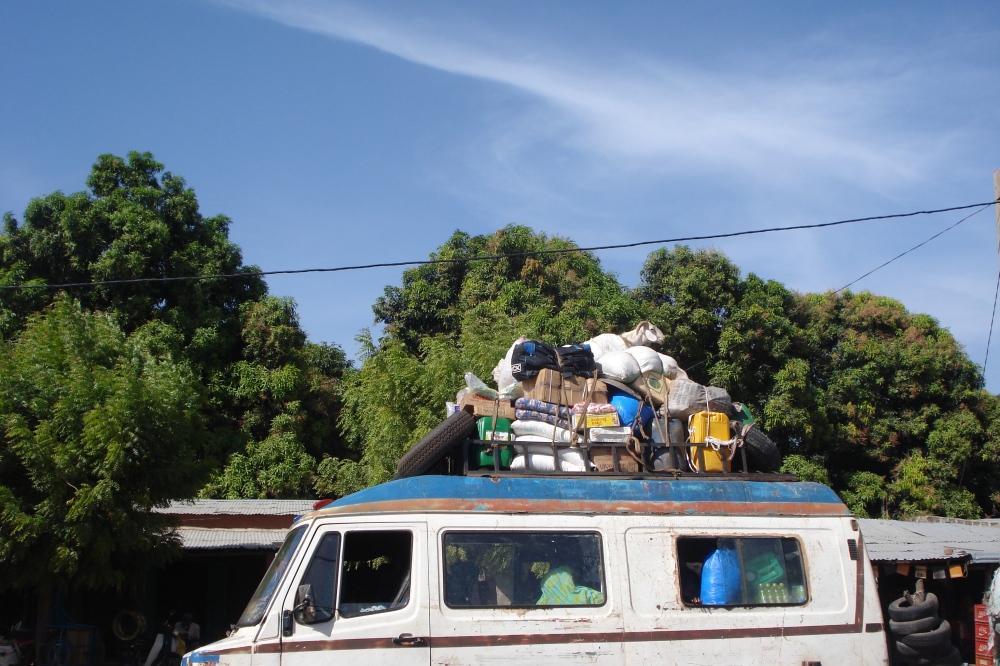
Fortunately though, people are friendly enough, and soon directed us to the right one, and we were on our way for 250CFA (about 40p for a journey that took about 45 minutes!) Now then, how many people do you think you can fit in a Sotrama (a ‘bus’ that has about as much space inside as a pick-up truck, covered). 10/11 maybe? 15 at a push? Yeah, try 23!! There was even a lady sat on the floor on a petrol can, though we’d have been in trouble had the police stopped us! We figured though that, although it’s very sweaty and very uncomfortable, it’s actually safer as you’re wedged in, so when you’re bumping around on the African roads, you can’t move!


Today was a day that basically sums up Africa to a tee, it’s quite amusing. As I said before, this morning we headed to Baguineda too late to actually do anything. On the way to Baguineda though, we saw two vans with about 50 goats each tied to the top, still alive, but tied lay down so they couldn’t move, then also a bus with about 100 tied to it! It makes me sad that they’re transported like this, but it’s their way of life so there’s nothing you can do. It’s because it’s Tabaski this weekend, and it’s tradition to kill a goat at the ceremony. Bleurgh. Fortunately, that’s a man’s job.
It wasn’t a wasted trip though, as we headed down to the river, about a 5 minute drive from Baguineda (I wanted to walk but they wouldn’t let me. I really miss walking; they never let me go anywhere, and I like just going for a wander on my own!) to a fishing village. Here, we hopped on a boat, drove across the river, casually picked up about 5 women, some bits and pieces…and a donkey! He was very cute (though they don’t think of animals like that here, they’re working animals. Sogodogo just laughed at us (in a nice way) when we said that he was cute and that we thought he was sad) and we petted him, and Alice even rode him!
He then had to get in the boat back over the river, which he didn’t like though, and they had to lie him down then pin him down so he didn’t jump out, which made me sad even though I knew it was just so that he wouldn’t hurt himself.


We went out for tea when we got back at a restaurant we like near the French Institute, which was nice, and then we hopped in a taxi back home, which was definitely interesting. As tends to happen a lot, the taxi broke down, but we were in the middle of a three-lane carriageway!
Jim and the driver managed to push us over to the side of the road fortunately, although there were a few hairy moments, and we stood waiting while two other taxis pulled over to help the driver. Then two military personnel came over, not to help, but to shout at us and tell us to move because we were on a military road, so two taxi drivers pushed the car back out onto the main road and round the corner, trying to dodge fast-moving traffic as they went.
We were taken by the third driver, first around the corner out of harm’s way, and then he agreed to take us home quite cheaply, so all was well. As a bonus, he loved Bob Marley (quite common here) and played it loudly all the way home, which was fun! None of this is out of the ordinary in our everyday lives, which I love!
8th November 2011It’s been a very busy, exciting and hectic few days so got lots to tell you this week, but I’m not entirely sure where to start! Not much happened for the rest of the working week last week, because people were winding down in preparation for Tabaski.
 |
| Gareth, the sheep outside my window |
This is the Malian equivalent of Eid, and is a huge event here; even non-Muslims celebrate it in their own way. It’s the Festival of Sacrifice, and so the main event of the whole day is the slaughtering of the sheep (or goat if you can’t afford one). Therefore, in the week running up to Tabaski (which was on Sunday), Bamako was filled with sheep and goats of all shapes and sizes. They were tied up everywhere you went, and I even had one outside my bedroom window for a while. I called him Gareth, and wanted to rescue him, but felt that they might notice if I had a sheep in my room, especially as it was the director who bought it.
 The city smelt of sheep, sounded like sheep and was generally just filled with sheep; they were loaded on the top of Lorries and Sotramas; people were carrying them (still alive) on motorbikes; there were people herding them by the dozen through the streets. I live in Yorkshire, and I have genuinely never seen so many sheep as I have this week!
On Thursday, we went out to an expensive, but brilliant Indian restaurant in the Hippodrome with Remi, our Canadian friend from work. It was so nice to have vegetables! We then went out for ice cream at our new favourite place; I can definitely recommend the melon and grenadine combination!
On Friday, we celebrated Shawana’s Malian birthday! Every week, we celebrate the ‘birthday’ of one person or another, just to make it a bit more special, and we all go out and do something. For Shawana, we went to the Patisserie for an hour or so, and then went back to their flat for a girly night, and did things like face masks, hair masks, and Sam (who should be a beautician) began doing Mehndi on us (designs with henna) which was amazing! We then tried to watch the film ‘Bridesmaids’ which was on Claire’s hard drive, but her speakers aren’t great to begin with, and there was a sheep bleating very loudly outside the window, so we gave it up for a lost cause.
 On Saturday morning, we went to visit another of International Service’s projects; a school called EDA. It’s a school for deaf children, and the last ICS cohort paid for them to have dance lessons and they were putting on a performance as part of a dance festival (you can tell I’ve spent too long in a French-speaking country, I keep wanting to spell it ‘danse’). We got there bright and early and watched them dance for about half an hour, and they were absolutely brilliant, we loved it! We also got to look quickly around the school, and saw the mural that the last cohort painted.
That evening, we had been invited to a Bonfire Party hosted by a British ex-pat who some of the others had met at the French Institute, and so we headed there about 7ish, armed with toffee apples and vegetable chilli. It’s amazing what you can make out here when you’re innovative! We got there just in time to watch the fireworks, which were brilliant, if a bit unreliable (they headed in directions we didn’t necessarily want them to go haha) and then had a chat with lots of lovely British and American people who had been invited. It was such a lovely evening, one of my favourites here so far. It’s amazing how quickly you crave familiarity, although I don’t think there’s anything normal about sitting around a swimming pool in November, discussing Wallace and Gromit!
We went home fairly early however, as the next day started bright and early. Sunday was Tabaski, and we had to set off to Dolo’s house at 8.30am, in order to get there for the start of the celebrations. Shawana and Sumera went earlier, as they went with them to the Mosque to pray. Dolo works with us for International Service, and very kindly invited us to his house to join his family celebrations, which was so lovely of him.
The tradition for Tabaski is to wear new clothes, so we went all out and bought traditional African clothes. They’re ridiculously cheap to say they’re tailored to exactly fit you; you buy the material for about 4000CFA and then take it to the tailors (this amounts to about £15 altogether!). They then measure you, and make the clothes to fit. This usually doesn’t take very long – a couple of days max – but in the run-up to Tabaski all the tailors are full to bursting, and the day before, many don’t close until the early hours of the morning in an effort to make all of their orders.

Dressed to the nines, we all set off to Dolo’s armed with juice, biscuits, cake and fruit as gifts. I had a minor issue with the top of my outfit, as even though they had altered it the day before, it was still too tight around my chest, so I found it difficult to breathe. Only a minor issue, but made the rest of the day rather uncomfortable haha. We found it quite difficult to get a taxi (think similar to getting one on NYE) but fortunately got two that weren’t too expensive.
Whilst waiting though, we witnessed two sheep being killed, which wasn’t particularly pleasant, but I didn’t look whilst they were doing the actual killing, and then it wasn’t too bad afterwards because the Halal way of slitting their throat is actually very neat and clean, and there wasn’t too much blood or anything. Fortunately we got to Dolo’s after they had killed the sheep, as apparently it didn’t make a very nice noise, and the muscles and things were still twitching after it was dead (sorry to anyone who is squeamish) and so wasn’t very nice to watch.
 When we got there, the corpse was hanging from a tree, and Adama (Dolo’s nephew, our interpreter at work) and his brother were cleanly skinning it and chopping it up. I surprised myself and didn’t mind watching it when it was dead; it was actually fascinating. They use all of the meat, including the bones, testicles and head. They burn and stew the bones and the head for breakfast the next morning (very glad I wasn’t there!!), and they put the testicles on the BBQ…fortunately didn’t have to eat those either! According to Dolo, they tend to give them to the children
All of Dolo and Adama’s family were very nice and very welcoming, and they put on quite a feast for us. To start with (at about 10am!) we were give the cake and biscuits we had brought, and then salad and chips with a bit of meat (this was whilst they were still cooking Mr. Sheepy, this one had been bought the night before). We then helped to prepare the sheep for the brochettes (like kebabs), and yes, even I did this! I couldn’t bring myself to eat any of Mr. Sheepy though… We then got brought the brochettes, and then some grain called Fonio, which was quite nice, but also covered in meat.

We spent the whole day there, just relaxing and chatting; they have a beautiful house, with a courtyard filled with mango trees, and it was really nice just to be in somebody’s home, as living in the office it doesn’t really feel like a home sometimes. At about 5ish, we then went with Dolo to say hello to some of his neighbours, who were again all really friendly and welcoming. As always, there are a lot of greetings to say in Bambara for such an occasion, and everyone is so nice, and welcoming and happy.
It was really nice to see everyone all dressed up and looking so pretty. We headed home after this however, as we were exhausted; it’s amazing how tiring being in the sun all day is, even if you’re not doing very much. I was also struggling in my restrictive top at this point, and so we headed to the main road to get some taxis; this again was difficult, and the traffic on the way home was ridiculous, as everyone was travelling to see family and friends.
14th November 2011
My favourite part of this week has been our trip to Siby. It’s a town about 45km outside Bamako (I don’t know how far that is in miles, and they don’t use those here) and is one of the most picturesque places ever! It has natural rock formations, waterfalls and hills, and you can basically walk, climb and swim to your heart’s content! We set off from Bamako at 8am on Saturday morning, and caught a bus for 1000CFA (about £1.70).
 When we got there, the bus was full, so we got on an empty one and waited…and waited…and waited. That’s how buses work here, they don’t have set times, they just go when it’s full, and their definition of full isn’t our definition of full. If there are 10 seats on a bus, you can guarantee there will be about 23 people on there, plus maybe a goat or two on the roof. Because we had waited so long and were quite a way off being full, Shawana and Dave decided to jump off and get a sandwich (I personally had brought an amazing watermelon jam sandwich!).
Typically though, two minutes after they had got off, the bus filled up and the driver started to drive off! I was desperately trying to save a seat for one of them next to me, despite abuse from the man behind me, and we had to ask the driver to wait while we searched for them. They arrived back 5 minutes later to see all 5 of us sticking our heads out of the windows and gesticulating frantically for them to hurry up. We then didn’t set off for another ten minutes. This is Africa after all.
 We were debating for a while as to whether to go to the waterfalls, but when we got there, we were so glad that we made the decision to go. It was a waterfall cascading down some big rocks, which we had to climb down, into the most amazing pool. It was crystal clean, and had some quite big fishies in which bit my toes! It was quite cold, but refreshing when it’s 35 degrees outside!
We swam in there for a while, and then climbed up the waterfall, and had a natural shower! People then got out to sit in the sun to dry off for a bit, but I decided to embrace the inner-explorer in me, and climb the big rocks next to us. It was really fun, and I felt quite intrepid as I was climbing through trees and things, but clever me did it in no shoes; fine on the rocks, as it gives you more grip, but once I got to the top, I had to walk through long grass to get back down. This is obviously not a problem in England, but in Africa there are snakes and scorpions. Whoops. I braved it though, and didn’t get bitten yay!
 We then headed back down, and then some of us had decided to stay overnight. It was only 1500CFA (about £3) and we got a cute little hut, which we shared between two of us, which had a double bed and a mosquito net, and the place had a shower and a toilet (a hole in the ground) what more do you need?? We’d decided to stay over because there is also a rock formation which created a natural bridge on top of a hill, and we wanted to walk up to there. It was only 5km there and 5km back, but we had to hire a guide, which was only 1800CFA each. We managed to get a good meal at the hotel, and went for a little walk for an hour, then got an early night, as we knew we’d been woken up early the next day (the huts were practically like sleeping outside, and life starts early here!)
Ten things I will miss about Africa;
- The people – Malians and ex-pats/volunteers alike, everyone is so friendly and welcoming. Although there we do receive a bit of overly-affectionate attention and occasionally get ripped off because we’re ‘Tubabus’ the general reaction from people is lovely, and I haven’t once been concerned for my safety whilst I’ve been out here in that respect
- The sun. In England I dread the summer; I am just not built to deal with heat. Here I’ve adapted surprisingly quickly and often feel comfortable walking around when it’s around 35 degrees outside. I’m not looking forward to the cold back home now.
- The novelty of seeing something new every day. Be it goats on top of a Sotrama, people dancing in the street, or a donkey crossing the road, there is always something new and interesting to look at here, and I’ll miss the grey androgyny of the UK on my return I think.
- The cheapness of taxis and being able to negotiate the price; when I get home I’ll forget how to use a taxi with a meter!
- The simplicity of life. Here, every morning I have a cold shower. When I wash my hair, it dries naturally, no hairdryer or straighteners, and with the exception of the occasional bit of mascara I haven’t worn make-up for almost three months, therefore it takes me a maximum of 20 minutes to get ready.
- The language. I’ve always loved French, and am determined to one day become fluent, even if I’m 50 before I achieve this goal. I also really like Bambara and, even though I can’t speak much, it’s really friendly and everyone constantly greets each other.
- Not being materialistic. Here, I haven’t missed things such as my iPhone at all, although I’m never away from it at home. I know I’ll get sucked back in once I return, but it’s nice for the moment to be without.
- Africa. I don’t know how to explain it unless you’ve been. Think of stereotypical Africa in your head – that’s pretty much it here in Mali, if you replace the lions and hyenas with goats, sheep and cows. Everything is busy and dusty, but laid-back and happy.
- The colours. Everyone here is so well dressed; quite conservatively normally, but in beautiful, brightly coloured African fabric, and it’s always so nice and interesting to look at as opposed to the samey-high street look back home.
- The food. To some extent. I quite like some of the things they have here; they always flavour things very nicely, and we’ve found some quite nice places to eat.
Ten things I won’t miss about Africa;
- Battling with the shower every morning because the plumbing isn’t great, and if I’m not super-quick when I wash my hair (even though I turn the water off whilst rubbing shampoo into my hair etc) I spend 20 minutes afterwards with a brush trying to stop the water from flooding into my room because it won’t drain
- The mosquitoes. I have been very lucky and they don’t seem to like me very much at all; I haven’t had to use my Deet since the first month. They are very annoying however, and I’ll be glad to not have to think about them, and to not sleep under my mosquito net.
- My bed. I didn’t mind it/quite liked it for the first two months, but now I’m craving (not mine, because mine at home is horrible too, but my stepsisters’) bed back at home. This one here is like sleeping on the floor with a bit of padding and my pillow is literally like a brick. No exaggeration. I want to sleep under a duvet here; normally I can’t sleep without something over me, but here it’s too hot sometimes for even my sleeping bag liner.
- The food. I don’t mind it, and can usually find things I like, but everything here is so samey. I want to be able to go to a supermarket and pick up some ingredients, and have a selection of things in, then be able to choose what to cook. I also want fruit and vegetables. And to not have a carbohydrate for every meal.
- Being ripped off. We don’t get it too much to be fair, and I can understand why they do it, but it’s really irritating for people to just assume you’re made of money because you’re white. A taxi-man the other day tried to charge is 5000CFA for a journey we normally only pay 1500CFA for, just because we were Tubabus.
- Being called a Tubabu. It’s not malicious in the slightest, but just occasionally it’s slightly exhausting to be surrounded by mobs of children every time you want to walk to the shop or go out for dinner, and to be noticed everywhere you go.
- Working on Mali-time. Our work is going quite slowly, because things don’t happen when they say they will, or they’ll say we can have the car, then when we turn up someone else will have it. Frustrating.
- The sun. Although I’ve adapted well, autumn and winter are my favourite seasons back home, and I’m sad I’m missing them. I also kind of miss all the build up to Christmas because I’m a child at heart.
- The dust/fumes/pollution. Here in Bamako, as it’s a big city, it’s constantly busy and full of people and traffic. Cars here do not have filters on their exhausts so the fumes are horrific. Add plumes of dust and some open sewers into the mix, and I can’t wait for the (relatively) clean air of London. My lungs won’t know what’s hit them when I get to Yorkshire!
- Being home. No matter how much I’ll travel and see the world, and believe that everyone should do so, I’ll always be a home girl at heart.
We had planned to go to a town called Sikasso the weekend just gone, but the plans fell through as people were ill and others had money issues. This turned out to be rather a good thing as on Thursday, two French people were kidnapped at a town called Hombari, and on Friday, four Europeans were kidnapped from Tombouctou.
The kidnapping in Hombari was the first south of the Niger River, and the ones in Tombouctou were the first in that area. The reasoning behind it is interesting I think; there was a meeting with a group of Muslims (I can’t remember which one) who openly stated that ‘All Muslims would stand with the ‘southern’ government.’ (i.e. the main government of Mali situated in Bamako). This did not sit well with AQIM (Al-Qaeda in the Islamic Maghreb), who are the group of rebels in the north who are usually responsible for the kidnappings.
They believe strongly in annexing the south from the north, and are completely opposed to the ‘southern’ government. The ‘best,’ or at least most attention-seeking way to show their outrage is to kidnap Westerners, because not only does it attract media attention, it also affects the economy of the country as tourism declines; the whole of Tombouctou was evacuated of tourists and masses of the country is already a red-zone to most white foreigners. This way the government is more likely to take action.

7th December 2011
We had to go into work for an important meeting with Mme. Coulibaly about our catalogue. I’d woken up that morning however, with a sore stomach and generally not feeling very well. I assumed that it was just normal for Africa however and, although I couldn’t eat my Nutella and banana sandwich that morning (sad times) headed to work feeling fairly perky.
As per usual however, we had to sit around waiting for a couple of hours, and as time wore on, I started feeling generally rubbish; I had a headache, my body was aching, I had a temperature, and eventually I had goosebumps even though it was around 30 degrees! At this point, Alice very kindly walked home with me so that I could take my temperature and lie down. My temperature was a bit high, but still within the normal range, so I just assumed it was nothing, took some paracetamol and chilled out for a bit.
When my temperature went up to 38 a couple of times however, I was a bit wary, and went to as the others what I should do; we have a rule that, whenever someone has a high temperature or a fever, they go to the Clinic just to be sure, as it’s the first sign of a lot of diseases out here. I was reluctant to go however, as it was only just 38 and kept fluctuating, and I was sure that it was just my body fighting off an infection; I didn’t feel too bad in the grand scheme of things. Also, we had planned to have a Christmas Carol concert on the roof that evening, and I knew that if I had to go to the Clinic I would miss it. I was bullied into going however, and Dave came with me.
I explained to the English-speaking doctor (very arrogant, but the best doctor in the place) my symptoms and he sent me for a blood test. After about 20 minutes the results came out, and I sneaked a look as I waited for the doctor again; positive. Damnit.
I knew in my heart of hearts that that was probably what was wrong with me because, having Googled the symptoms I could tick off 7/10 of them. Still didn’t fancy an overnight stay in the hospital though.
Very fortunately, because people had made me go, they had caught it in the very early stages, and I just needed lots of rest and some strong drugs and I’d be right as rain again. As the Doctor said, “It is just ‘little’ malaria” so no hospital stay required! I wouldn’t have minded really, as it’s a really nice Clinic (the best in Mali) but if you can avoid a stay in hospital then you do!
I spent the next day feeling fairly rubbish, but ok to say I had malaria! It felt a bit like a very mild case of the flu and I completely lost my appetite. Everyone looked after me really well though, and I soon recovered, though it took a few days before I was back to normal.
On Monday, it was International Volunteers Day around the world. Mali really got into celebrating this, as they have a lot of volunteers here, and Dolo had spent lots of time, with lots of other organisations, organising a celebratory day. It kicked off at 7.30 as we had to go and set up our stall; then we went into a big conference room with organisations such as the Red Cross, Peace Corps and the Scouts (yep, they have Scouts here in Mali). The President and the Prime Minister were here, and we had to stand up every time the President did, which was a bit odd.
We sat through about two hours of speeches, interspersed with a random rap from an apparently famous Malian rapper, who lip-synced horribly to a track. Alice and Shawana then went downstairs before us, and along with Dolo and Fred, got to meet the President! We all stood behind, trying to take photos over peoples’ heads and avoiding the scary-looking military men. After this, we had a football match between the different organisations; Lucy, Sophie, Dave, James, Adama and Dan all played and the blues won (a team with Dan and Adama on). That evening we were supposed to have a Cultural Night at the Maison des Jeunes but we were all exhausted from the day, and it wasn’t great so we all came home quite early.


All in all, I had an amazing three months in Mali! It was difficult at times, but it's now one of my favourite places in the world, and I hope to go back soon!

.jpg)


.jpg "Goat on a Sotrama")


.jpg "Artisan Loom")


.jpg "Celebrating")
.jpg "Children")